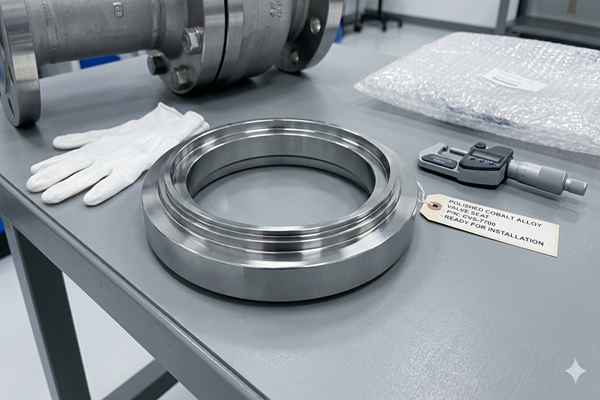
Ordering custom cobalt alloy steam valve parts is not the same as buying standard bar stock or a catalog spare. Valve seats, seat rings, discs, wedge sealing components, and trim parts usually need to match a specific valve design, sealing geometry, material requirement, and operating condition.
For purchasing teams and valve OEMs, the fastest way to receive a useful quotation is to prepare the right technical information before sending an RFQ.
TP Alloy supports custom cobalt-based alloy valve components based on drawings, samples, or failed-part photos. This guide explains what to prepare and how the manufacturing review normally works.
What Types of Steam Valve Parts Can Be Customized
Steam valve wear parts may have different names depending on the valve design. A buyer may call the part a valve seat, but the drawing may describe it as a seat ring, sealing ring, disc, wedge, plug, or trim component.
Common custom parts include:
- Steam valve seats
- Seat rings
- Valve discs
- Wedge sealing components
- Plug and seat parts
- Trim wear parts
- Hardfaced or cobalt alloy sealing components
- Replacement parts made from samples
The part name alone is not enough for production. The drawing controls the actual geometry, tolerance, sealing surface, and machining requirements.
What Buyers Should Prepare Before Requesting a Quote
A clear RFQ helps avoid repeated communication and incorrect assumptions. Before requesting a quote, prepare as much of the following information as possible:
- 2D drawing or 3D model
- Material grade or equivalent standard
- Quantity
- Critical dimensions and tolerances
- Required sealing surface finish
- Working temperature and pressure
- Valve type and application
- Existing failure problem, if any
- Photos of the sample or failed part
- Required inspection documents
- Delivery country and target delivery time
If the original material is unclear, tell us what is written on the drawing, purchase specification, or maintenance record. TP Alloy can then review possible cobalt alloy options instead of guessing.
How TP Alloy Reviews a Drawing
The first step is not simply to calculate a price. A drawing review checks whether the part can be made reliably and what production route is practical.
During review, TP Alloy looks at:
- Part geometry and wall thickness
- Machining allowance
- Sealing surface requirement
- Dimensional tolerances
- Material grade or equivalent standard
- Casting feasibility
- CNC machining difficulty
- Inspection points
- Whether a sample is needed for confirmation
For a steam valve seat or disc, the sealing face is especially important. A good alloy choice cannot compensate for poor geometry, unstable contact pattern, or uncontrolled finishing.
Possible Manufacturing Routes
Not every steam valve part should be made by the same process. The manufacturing route depends on drawing, size, material grade, quantity, and service condition.
Possible routes include:
- Cobalt alloy casting followed by machining
- Blank preparation followed by CNC machining
- Machining from plate, bar, or near-net-shape material
- Sealing surface finishing after machining
- Custom inspection before shipment
For some valve parts, the customer may need a solid cobalt alloy component. For other parts, the requirement may involve a cobalt alloy surface or hardfaced sealing area. These are not the same manufacturing problem, so the drawing and specification should be checked carefully.
Quality Checks Before Shipment
Procurement teams usually care about two things: whether the part matches the drawing, and whether the material is traceable. TP Alloy can support inspection based on project requirements.
Typical checks may include:
- Dimension inspection
- Hardness test
- Chemical composition review
- Surface inspection
- Sealing surface visual check
- Photos before shipment
- Packing check
- Material certificate or inspection record when required
For critical steam valve parts, buyers should state document requirements before ordering, not after production is finished.
RFQ Checklist for Custom Steam Valve Parts
Before sending an inquiry, use this checklist:
- Do you have a drawing?
- Is the material grade or standard specified?
- Which surface is the sealing surface?
- What is the working temperature and pressure?
- Is the part used in a gate valve, globe valve, check valve, control valve, or another valve type?
- Is the part new production or replacement for a failed component?
- Do you need a material certificate, hardness report, or dimension report?
- What quantity do you need?
- What is the destination country?
The more complete the information, the faster TP Alloy can review manufacturability and provide a practical quotation.
Start Your RFQ
Send your drawing, material requirement, quantity, and application information for review.
For faster communication, contact TP Alloy by WhatsApp / WeChat: +86 130 0924 9727.
If your website inquiry requires email, use the email address shown on tpalloy.com so the request reaches the correct sales channel.
FAQ
Can TP Alloy quote without a drawing?
It depends. A drawing is strongly recommended. If a drawing is not available, sample photos, dimensions, material information, and application details can support an initial review.
Are all steam valve seats made by casting?
No. Some parts may be cast and machined, while others may be machined from prepared material or require a surface-focused manufacturing route. The drawing decides the route.
Can you manufacture from a failed sample?
In some cases, yes. Clear photos, dimensions, and the failed sample can help, but a drawing is still preferred for final confirmation.
What documents should buyers request?
Common documents include dimension inspection, material certificate, hardness test, chemical composition review, and shipment photos.
