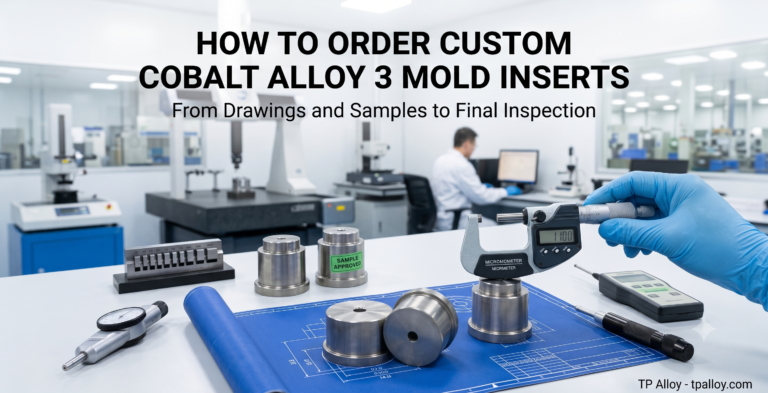
Ordering custom Cobalt Alloy 3 preform mold inserts is a technical purchasing task. A supplier cannot quote accurately from a material name alone. The drawing, part geometry, hardness requirement, inspection method, sample testing plan, and acceptance criteria all matter.
TP Alloy supports custom Cobalt Alloy 3 / UNS R30003 / ST3 preform mold inserts for injection molding machine applications based on drawings, samples, or customer specifications.
What Types of Preform Mold Inserts Can Be Customized
Different mold designs use different insert names. A buyer may request a preform insert, but the drawing may describe the component as:
- core main insert
- cavity insert
- inner ring insert
- preform mold insert
- forming insert
- replacement insert based on sample
The part name should always be confirmed from the drawing. Two inserts with similar names may have different critical surfaces, tolerances, and inspection points.
What Buyers Should Prepare Before RFQ
To receive a useful quotation, prepare:
- 2D drawing or 3D model
- sample photos if available
- required material: Cobalt Alloy 3 / UNS R30003 / ST3
- hardness requirement or target range
- critical dimensions and tolerances
- surface finish requirement
- quantity
- inspection requirements
- whether sample production is required before batch order
- whether magnetic response checking is required
- whether porosity or internal defect inspection is required
If the requirement is not clear, TP Alloy can review the drawing and help list the missing information before quoting.
How TP Alloy Reviews Drawings and Technical Requirements
The drawing review focuses on manufacturability and inspection risk.
TP Alloy checks:
- part geometry
- machining difficulty
- key forming surfaces
- tolerance requirements
- material requirement
- hardness requirement
- inspection points
- whether a sample should be made first
This is different from a simple price quote. For precision mold inserts, the goal is to prevent misunderstandings before production starts.
Sample Production and Approval Process
For new projects, sample approval is often the safest first step.
A practical process may be:
- confirm drawing and material requirement
- confirm inspection method and acceptance criteria
- produce sample
- inspect dimensions
- perform hardness testing
- check magnetic response if requested
- complete surface and visual inspection
- send photos, reports, or videos for customer review
- customer approves sample before batch production
This process helps reduce procurement risk and makes batch quality expectations clearer.
Quality Inspection Before Batch Delivery
Before batch delivery, buyers may request:
- material certificate
- chemical composition report
- hardness report
- dimension report
- visual inspection photos
- magnetic response check if required
- porosity or internal defect inspection under agreed method
- packing photos
For porosity and internal defects, the acceptance language should be clear. The recommended wording is: no unacceptable porosity or internal defects under the agreed inspection method and acceptance criteria.
RFQ Checklist for Custom Cobalt Alloy 3 Mold Inserts
Before sending your RFQ, check whether you have:
- drawing
- sample photos
- material requirement
- hardness range
- quantity
- inspection requirements
- sample testing requirement
- magnetic response check requirement
- internal defect inspection requirement
- delivery country
For faster communication, contact TP Alloy by WhatsApp / WeChat: +86 130 0924 9727.
If your company requires email communication, use the email address shown on tpalloy.com.
FAQ
Can TP Alloy manufacture from samples?
Samples can help with initial review, but drawings are preferred for final manufacturing confirmation.
Can you make samples before batch production?
Yes. Sample production and approval can be arranged when agreed before order.
Can magnetic response be checked?
Yes. Cobalt Alloy 3 is extremely weakly magnetic in practical inspection. Magnetic response checking can be included if required.
Can internal defects be inspected?
Inspection method depends on part geometry and agreed acceptance criteria. This should be discussed before production.
