
our homogenizer fails when processing acidic foods. This downtime costs money and creates production delays. Understanding why your super duplex valve seats fail is the first step to a real solution.
Super duplex stainless steel valve seats often fail in acidic food applications due to a combination of factors. The material’s protective passive layer is attacked by low-pH conditions and chlorides, leading to localized pitting and crevice corrosion. This, combined with high mechanical stress, causes premature failure.
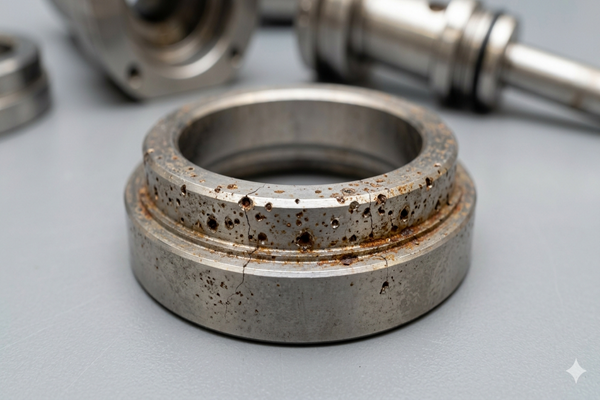
The failure of a valve seat seems like a simple mechanical issue, but it’s often a complex chemical problem. The material you choose has to fight a battle on multiple fronts: high pressure, constant impact, and an aggressive chemical environment. When one of these factors is underestimated, failure is inevitable. So what really happens at a microscopic level when you pump tomato sauce or citrus juice through a super duplex valve assembly? Let’s explore the specific ways these components break down.
How does pitting corrosion destroy super duplex valve seats?
You notice tiny, deep holes appearing on your valve seats. These pits grow quickly, compromising the seal, causing pressure loss, and leading to unexpected equipment failure. Preventing them starts with understanding them.
Pitting corrosion attacks super duplex valve seats when chlorides in acidic foods break down the material’s protective surface layer. This creates small, concentrated corrosion zones that rapidly eat into the metal, leading to deep pits that undermine the valve’s sealing capability and structural integrity.
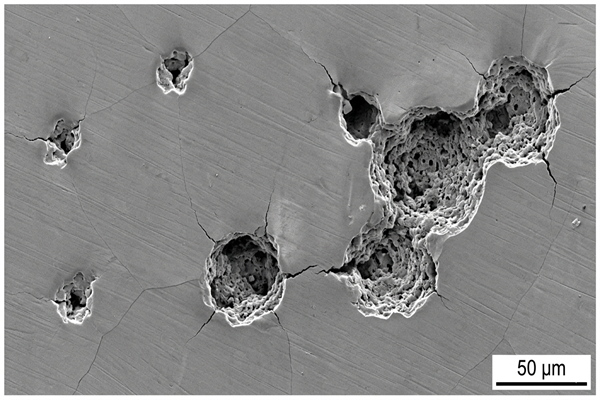
Pitting is one of the most destructive forms of corrosion because it’s so localized. A client who was processing a salted tomato paste. Their super duplex seats were failing every few weeks. We put a failed seat under a microscope and saw these deep, narrow pits. It was a classic case of chloride attack in a low-pH environment. The bulk of the material looked fine, but these tiny holes were enough to cause a complete loss of sealing pressure.
The Role of Chlorides and pH
The main job of stainless steel’s passive layer is to protect the metal underneath. However, chloride ions, which are common in many food products like sauces and brines, are very good at breaking down this layer. When you combine chlorides with a low pH (acidic) environment, the attack becomes much more aggressive. The acid helps dissolve the passive layer, giving the chlorides a direct path to the raw steel beneath.
The Vicious Cycle Inside a Pit
Once a pit starts, it creates its own destructive micro-environment. The solution inside the pit becomes even more acidic and concentrated with chlorides than the surrounding product. This process is autocatalytic, meaning it feeds itself. The corrosion creates conditions that accelerate even more corrosion, causing the pit to grow deeper and faster until it penetrates the component.
| Factor | Promotes Pitting | Resists Pitting |
| Environment | High Chlorides, Low pH | Low Chlorides, Neutral pH |
| Temperature | High | Low |
| Surface Finish | Rough, Scratched | Smooth, Polished |
| Flow | Stagnant or Low Flow | High, Consistent Flow |
Is crevice corrosion the silent killer for homogenizer seals?
Your valve seats are failing, but the main surfaces look fine. This hidden corrosion, occurring in tight gaps, can cause sudden seal failure and contaminate your entire batch. Understanding this silent killer is essential.
Crevice corrosion is a major threat to super duplex seats in homogenizers. It attacks the metal in tight, shielded areas, like under gaskets or between mating parts. Stagnant fluid in these crevices loses oxygen, creating an aggressive, acidic micro-environment that rapidly corrodes the steel.
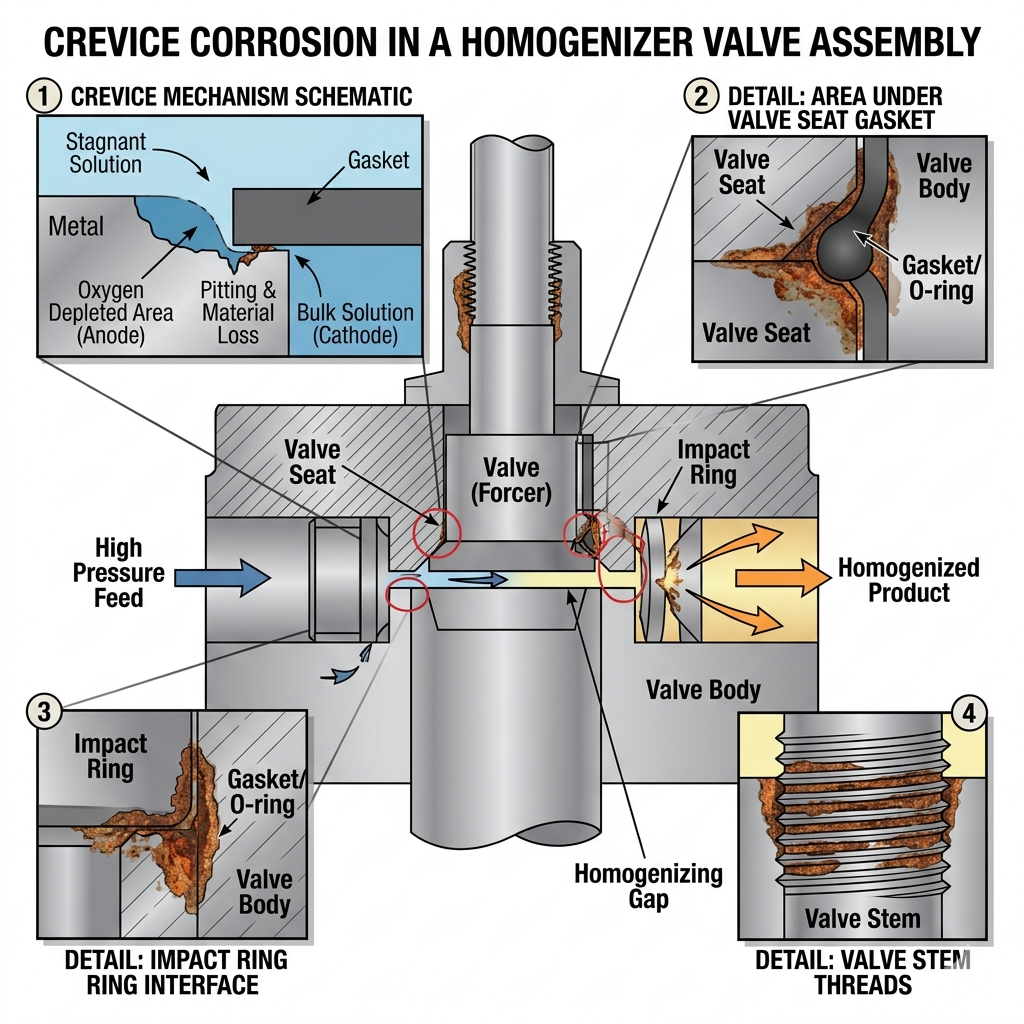
Crevice corrosion is tricky because you can’t see it during a routine visual inspection. We once worked with a beverage company making a citrus-based product. They were frustrated with random pressure drops. When we disassembled the valve assembly, the main seating face looked almost new. But the area where the seat was pressed into the housing was severely corroded. The design itself had created a perfect crevice, trapping the acidic liquid and allowing this hidden corrosion to destroy the part from the inside out.
How Oxygen Depletion Starts the Attack
Stainless steel needs oxygen to maintain its protective passive layer. In a tight crevice, the fluid is stagnant. The small amount of oxygen in the trapped fluid is quickly used up. Without fresh, oxygen-rich product flowing over the surface, the passive layer cannot repair itself if it gets damaged. This makes the area inside the crevice vulnerable and active, while the area outside remains passive. This difference in electrical potential turns the crevice into a corrosion hotspot.
The Importance of Component Geometry
The physical design of the valve and seat assembly plays a huge role. Any feature that creates a tight gap where fluid can become trapped is a potential site for crevice corrosion. This includes threads, gasket-to-metal interfaces, and press-fit joints. Even microscopic gaps are large enough for this process to begin.
| Design Feature | Promotes Crevice Corrosion | Minimizes Crevice Corrosion |
| Joints | Press-fits, Threaded Connections | Welded Joints, Smooth Transitions |
| Gaskets | Hard, Non-absorbent Materials | Soft, Compliant Gaskets |
| Surface | As-machined, Rough | Polished, Free of Gaps |
| Cleaning | CIP Cycles Miss Trapped Fluid | Design for Full Drainage (DFD) |
Can mechanical stress make chemical corrosion worse?
Your valve seats are not just wearing down; they are cracking. This dangerous combination of high pressure and chemical attack can lead to sudden, brittle fractures and catastrophic equipment failure. Recognizing this threat is critical.
Yes, the intense mechanical stress in a high-pressure homogenizer dramatically accelerates chemical corrosion. This phenomenon, known as Stress Corrosion Cracking (SCC), occurs when tensile stress and a corrosive environment work together to create and grow cracks much faster than from either factor alone.
The forces inside a homogenizer are immense. A plant that made salad dressings, which have high vinegar and salt content. They showed me a box of failed super duplex valve seats, and many were literally cracked in half. This wasn’t erosion or simple pitting; it was a clear case of SCC. The constant cycling from zero to thousands of PSI put the material under incredible tensile stress. Combined with the acidic, chloride-rich product, it was a recipe for disaster. The material became brittle and fractured under load.
The High-Pressure Hammer
Every cycle in a homogenizer acts like a hammer blow, creating and relieving stress on the valve seat. This constant flexing, even at a microscopic level, puts the material’s grain structure under immense strain. This tensile stress makes the material more susceptible to chemical attack along the grain boundaries, which are the weakest points. It essentially pulls the metal apart while the acid eats away at the newly exposed surfaces.
How Cracks Create New Problems
Once a micro-crack forms from stress, it acts like a tiny crevice. The acidic product gets inside, and the tip of the crack becomes a highly active corrosion site. The pressure from the homogenizer then acts like a wedge, forcing the crack open wider. This exposes fresh, unprotected metal, which immediately starts to corrode, and the cycle repeats. This synergy between mechanical force and chemical attack is why SCC leads to such rapid, unexpected failures.
| Contributing Factor | Description | Mitigation Strategy |
| Tensile Stress | High operating pressure, press-fits | Material with higher strength, proper installation |
| Corrosive Media | Low pH, high chlorides (acids, salts) | Use an intrinsically corrosion-resistant material |
| Temperature | Higher temperatures accelerate reactions | Process at the lowest possible temperature |
| Material Choice | Austenitic stainless steels are susceptible | Select materials immune to SCC, like cobalt alloys |
Why are cobalt alloys a better choice for acidic applications?
You’re stuck in a cycle of replacing failed super duplex parts. The costs of components, labor, and lost production are adding up. The good news is that a material exists that is specifically designed for these conditions.
Cobalt alloys are superior because their corrosion resistance is an inherent property of the metal itself, not dependent on a fragile passive layer. Their stable chemistry and extreme hardness provide outstanding resistance to the combined attack of acids, chlorides, and high-pressure wear, ensuring a much longer service life.
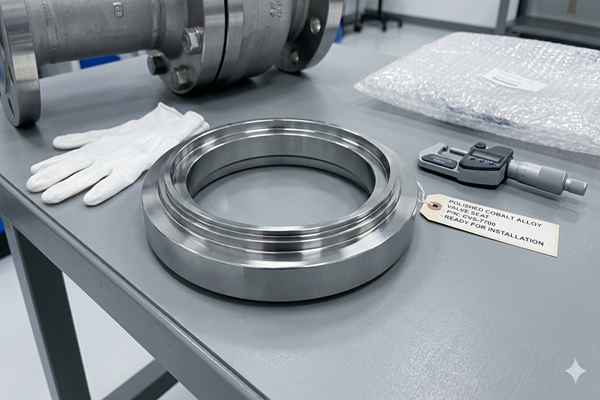
The client with the tomato paste problem who was replacing seats every few weeks. They were at their wit’s end. We analyzed their process and recommended a switch to our custom cobalt alloy valve seats. After they made the change, their replacement interval went from weeks to months. The initial part cost was higher, but their return on investment from increased uptime and reduced maintenance was enormous. It fundamentally changed their production reliability.
Intrinsic Corrosion Resistance
The biggest difference between cobalt alloys and stainless steels is how they resist corrosion. Stainless steel relies on a thin, invisible layer of chromium oxide on its surface. As we’ve seen, this layer can be destroyed by chlorides and acids. Cobalt alloys do not need this layer. The alloy itself—a matrix of cobalt, chromium, tungsten, and carbon—is chemically stable and highly resistant to attack. It simply does not react with the acidic, chloride-rich environments that destroy super duplex steel.
Unmatched Hardness and Wear Resistance
In a homogenizer, the valve seat must endure thousands of high-velocity impacts per minute. Cobalt alloys are significantly harder and more resistant to wear and galling (a form of wear caused by adhesion between sliding surfaces) than even the best stainless steels. This means they maintain their critical sealing geometry for much longer, preventing leaks and ensuring consistent product quality.
| Property | Super Duplex Stainless Steel | Cobalt Alloy |
| Corrosion Mechanism | Relies on a passive oxide layer | Intrinsically resistant base metal |
| Acid/Chloride Resistance | Vulnerable to pitting, crevice, SCC | Excellent, immune to these failures |
| Hardness (Typical) | ~28 HRC | 56-60 HRC |
| Wear & Galling | Good | Excellent |
| Service Life (Acidic Food) | Short (Weeks to Months) | Long (Months to Years) |
Conclusion
Super duplex steel fails in acidic food homogenizers from pitting, crevice corrosion, and stress. Cobalt alloys provide a far more durable and reliable solution for these demanding applications.
